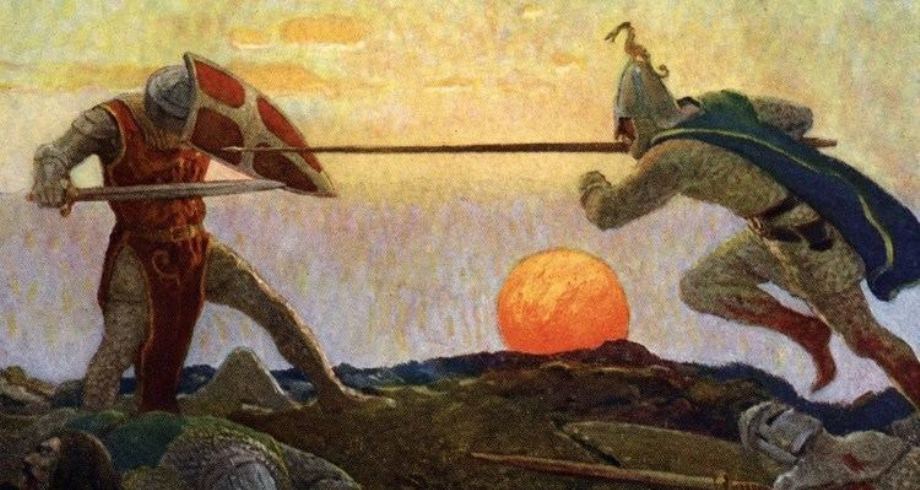
“But, O! Ye dear partners of this cruel strife, though fallen you are not forgotten! Often, with tears do we see you still, as when you rejoiced with us at feast, or fought by our sides in battle.”
***
Here’s to the flawed knights,
Doomed to be scattered
On Camlann’s cursed plain,
Strewn in the storied mist
Where kindred blood rushes,
Serpents undulate,
And only ravens sing.
Knightly names, these,
Mixing with wine
And undimmed in memory
For those whose hearts
Still enclose the Crown.
All are accounted for
In the scarlet assembly:
The Covenanter’s son is here,
Whose sires scribed their names
On Scripture’s awful page
With their life’s crimson flow.
His sword points to the sky as he climbs,
And his blood serves as ink, sealing his oaths,
Stamping them with many wounds
And staining the earth’s floor purple.
He is the fallen father of all under him,
Garnering them ageless glory,
Even from the grave.
We shall not see his like again,
In his fierceness, nor his gentleness.
But see one who mourned him:
The Gentleman playwright appears,
Leading his calamitous campaign
In his pressed uniform and plumed hat,
Gambling everything for Jerusalem
And riding between the ranks
Like the roaring Lionheart
At the height of his legend.
Had the dare paid out dividends,
We would recall his sonorous speeches
With animation and admiration.
Perhaps we still should,
On this sorry side of modernity.
At least someone tried to stem the tide.
Nearby, we see his confidante:
The Highland hero remains unmoved,
Holding the center atop his steed,
Undeterred by inordinate targeting,
For he has a host’s soul in him,
And will not be exiled from that spot,
Short of death’s bidding.
Duty holds him captive,
And he honors the chain,
Even as it pulls him down.
He has slain beasts and men
At the peak of his prowess,
But now, receiving his mortal hurt,
Even the laundry women
Weep over his weakness
And descent into shadow.
Their tears, perhaps, are his richest prize
And sweetest proof of worth.
Now see his fellow Celt:
The Welsh warrior directs his big guns,
And declares that men can go
Where goats have gone,
No slope too daunting to perch upon
Nor bastion to overtake.
He has old blood, good blood,
Dragon’s blood and fire
Pulsing through princely veins,
The substance that defended the Sepulcher
And bore the spurs and cups of kings.
Fever may prostrate him,
But never pillage his pride.
It goes with him into the ground,
And will someday make the earth shake.
Off to the south, in a captured city,
There’s the little Huguenot,
In his armor, with his lance,
Tilting as a champion of the fair,
Reciting tributes to Arthur’s court
And lilting tunes under his breath.
A slight frame, a fair face,
Pleasant in polite society
And steely in his sovereign’s cause,
He declares the day of his own death
To contain his most glorious hour.
Generous in life and gallant at its close,
The poison of disgrace will not besmirch him,
But only those who make Mercy weep.
Deprived of earthly clemency,
He yet submits to his arrest
By the Eternal Council
Of Sovereign Love,
And, performing his own last ordinance,
He lays claim to a Hiding Place.
Further south, along the frontier,
The Scots Bulldog calls the loyal to camp.
Marked by a crippled arm and an elfish visage,
He comes to restore the dispossessed,
Aid the widow and the orphan,
Succor the unoffending Friend,
And send traitors to Hell.
He dons his checkered duster,
Fit for a hunt on the King’s mountain,
A silver whistle at his mouth,
And vinegar on his tongue.
He will be shot, be dragged,
Beaten and broken,
Stripped and defiled,
But he will not surrender,
And cuts down the white flag,
And then the vulture, who thinks him dead,
And seeks to steal his sword.
He shall hold that high ground
‘Til the stars’ vigil ends.
And who is their liege,
Enthroned across the sea,
For whom so much is sacrificed?
He wears well the royal robes
And the red tunic,
A king of piety and purpose,
Determined to maintain his territories
And uphold the rule of law.
But more important, yes, more, to him,
Is God’s command,
And the Redeemer’s Conquest.
If slander and sedition are his to endure,
And sickness and suffering afflict him,
He will not sink beneath despair
Nor abandon his Lord.
Did he not once remove his own crown
Before the Table of the Lamb,
In recognition that his own King
Was wreathed by sharpest thorns?
We must ask:
Who can be a failure
That keeps such a Faith,
Or who remains faithful
To such a sovereign?
And so, the bard yet has cause to sing:
Hail to you, who lost the war,
Victorious in defeat!
Hail to you, of the old empire,
From wherever you sprung!
Hail to you, united across oceans,
United, even returned to dust!
You are wearied from hunting,
And sick at the heart,
And fain would lie down.
But it is better to fall with your kind
Than to rise with many others.
You will yet rise, by God;
When bones are beautified again,
And I will be there, still,
To sing your songs,
For if Mercy has its will,
The change from this world
To another one
Shall not be for the worst.
Leave a Reply